
How to Search Solano County Court Records
The main system for case lookups is the Solano Superior Court Public Portal. The portal lets users search case data and gives parties an enhanced view of their case from the court's case management system. To search case data or view electronic case files, you must create a free account first. The portal does not show confidential cases or confidential documents, and it is not a one-click anonymous record viewer.
Before you start, gather what you can. The exact case number is the fastest way to a hit. If you do not have it, you need at least two characters in the last name, first name, or company name field. A date range helps when the name is common. Have a valid email and a phone number ready for registration, plus a government photo ID if you plan to apply for expanded access under California Rules of Court 2.515-2.523.
- Open the public portal and click Register. Provide email, password, name, and phone, then check the terms box and select Create New Account.
- Log in to the User Home Page and click Case Search.
- Enter the exact case number when you have it. If not, type at least two characters into Last Name, First Name, or Company Name.
- Narrow by Filing Date From and Filing Date To if the name is common.
- Click Search and open a result to view the docket, parties, and hearings.
- For hearings only, use the court calendar. The keyword field accepts a name or case number, and the Hearing Type dropdown filters event types.
- For a certified copy or an older paper file, file Local Form 4021, Request for Record Search and Copies, with the right division and pay the fee in advance.
Solano's court records page tells visitors a key rule. Records are kept at the branch where the hearing was heard. Fairfield and Vallejo branch information for criminal matters goes through the Criminal Department. Record-search hours are Monday through Friday, 8:00 AM to 3:00 PM, excluding court holidays. Lead-in for the screenshot: the court's online services hub links case search, clerk appointments, calendar, reporter transcripts, and ADA tools.
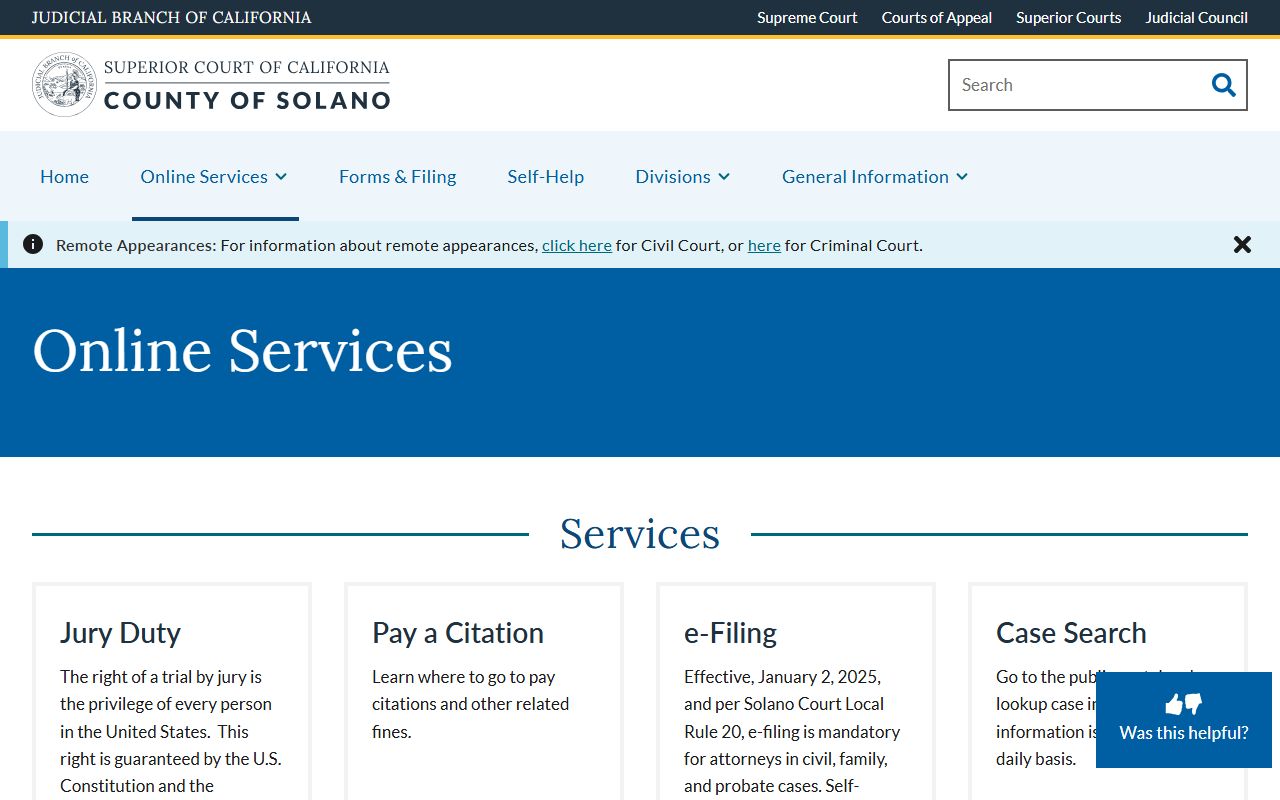
The hub is where most users start. From there, you can reach the portal, the calendar, the clerk-appointment tool, and self-help resources without guessing at URLs.
The Solano County Judicial System
California uses a single Superior Court per county. There are no separate justice-of-the-peace courts, county courts at law, or stand-alone probate courts. The Superior Court of California, County of Solano is the unified trial court for every general and limited jurisdiction matter in Solano. Subject-matter divisions and numbered departments handle criminal, traffic, civil, small claims, family law, probate, juvenile, guardianship, conservatorship, and unlawful detainer cases. Appeals leave the trial court and move to the California Court of Appeal, First Appellate District. The California Supreme Court is the court of last resort.
Solano sits in the First Appellate District. The court's About the Court page lists 23 judicial officers and roughly 200 staff, working from four facilities. Recent leadership snippets identified Presiding Judge William Pendergast III and Court Executive Officer Brian K. Taylor; check the official About page for the current names.
Case flow: Superior Court (trial) › California Court of Appeal, First Appellate District › California Supreme Court
| Court | Jurisdiction | Case Types |
|---|---|---|
| Solano Superior Court | Trial court, general and limited | Felony, misdemeanor, traffic, civil, small claims, family, probate, juvenile |
| California Court of Appeal, First District | Intermediate appellate | Appeals from Solano Superior Court rulings |
| California Supreme Court | State court of last resort | Discretionary review of appellate decisions |
| U.S. District Court, Eastern District of California | Federal trial | Federal crime, federal civil, habeas, civil rights |
| U.S. Court of Appeals, Ninth Circuit | Federal appellate | Appeals from Eastern District |
Civil case tiers matter for filing and search. Small claims covers disputes under $12,500. Limited civil covers cases up to $35,000. Unlimited civil covers cases over $35,000. The court's civil filing instructions page lists those thresholds and the forms each track needs.
Solano County Courthouses
The court operates from four buildings. Three sit in downtown Fairfield within a short walk of each other. The fourth is in Vallejo and handles Vallejo and Benicia branch matters. All buildings require security screening, and all are wheelchair accessible with elevators and accessible restrooms. Lead-in for the screenshot: the official court locations page lists every facility, plus parking, transit, Wi-Fi, and accessibility detail.
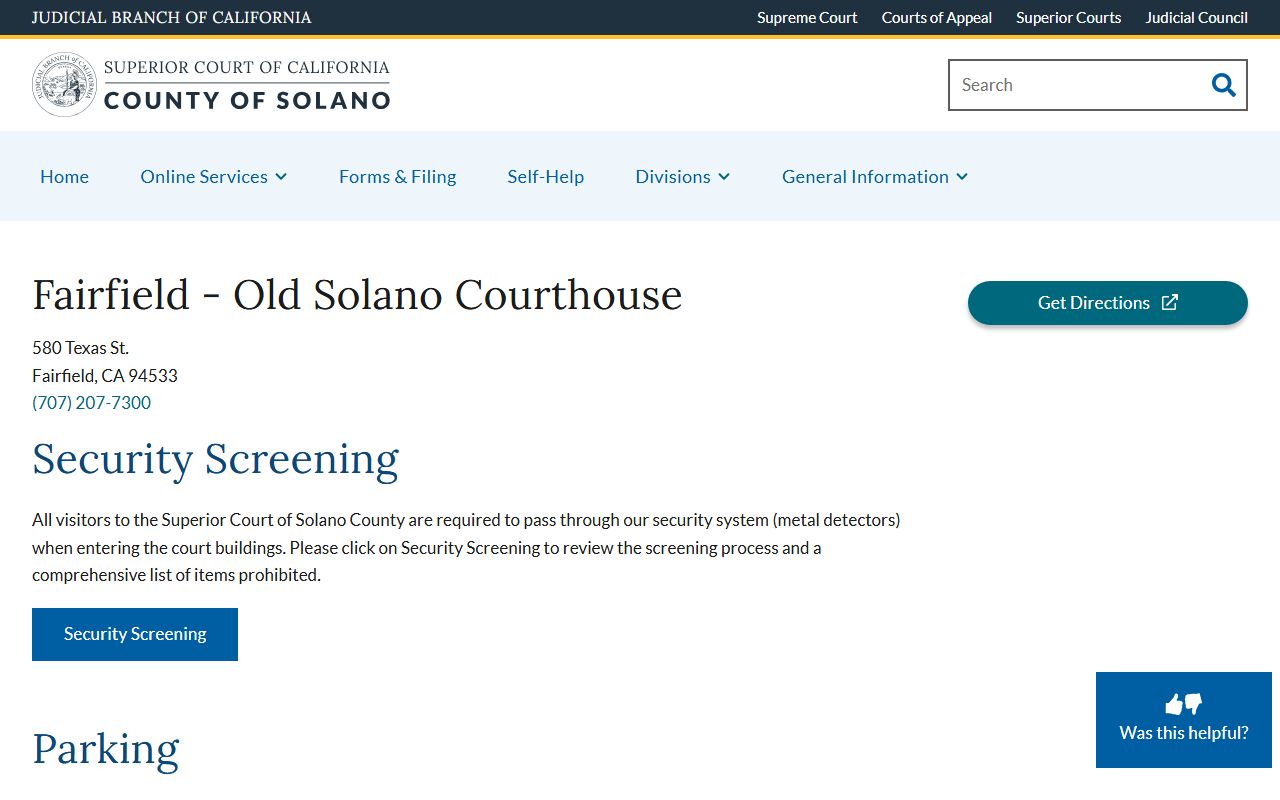
Use the address cards below for in-person visits, mail, and phone contact.
The Hall of Justice is the public-facing main courthouse for most record visits. Courthouse hours are 8:00 AM to 5:00 PM. Clerk drop-in hours run from 8:00 AM to 11:30 AM, with appointments from 8:00 AM to 3:00 PM. The Family Law Division is on site at the Hall of Justice, with a clerk phone of (707) 207-7340.
Types of Court Records Available in Solano County
Solano Superior Court produces records across every trial-court division. Civil files cover lawsuits over money, property, contracts, evictions, name changes, and small claims. Criminal files include misdemeanors and felonies filed by the District Attorney or by grand jury indictment. Family Law files include divorce, parentage, custody, child support, and restraining orders. Probate files cover estates, wills, trusts, conservatorships, and guardianships. Juvenile files are mostly confidential under state law, and traffic files cover infractions and certain misdemeanor traffic charges.
Most case data is searchable from the same public portal. Confidential records, sealed records, and juvenile files do not show up in ordinary public searches. The court's Criminal Records, Fees and Forms page describes how criminal record review works and lists local case-number prefixes.
- Criminal records - Solano misdemeanor and felony cases, with local prefixes F, FC, FCR, M for Fairfield-side filings and V, VC, VCR, F, M for Vallejo and Benicia.
- Civil records - small claims under $12,500, limited civil up to $35,000, and unlimited civil over $35,000.
- Family and divorce records - dissolution, legal separation, custody, support, paternity, and domestic violence cases.
- Probate records - decedent estates, conservatorships, guardianships, and trust petitions.
- Traffic records - citations, arraignments, bail, traffic school orders, and failure-to-appear matters.
- Warrant records - bench warrants tied to court cases, viewed through the public portal.
What Solano County Court Records Show
A Solano court record is more than a name and a case number. The file holds the full path of the case from start to disposition. Most public files include a case caption, party names, attorney names, filing date, case type, hearing minute orders, motions, orders, judgments, and notices. Some include scanned documents, financial entries for fees and bail, and disposition notes. Confidential fields, sealed items, and minor identifying details are masked or restricted by statute and rule.
| Field | What It Shows |
|---|---|
| Case Number | Local prefix plus year and sequence; common examples include CL, CU, F, FCR, FL, FS. |
| Case Caption | Plaintiff v. defendant, petitioner v. respondent, People v. defendant, or In the Matter of. |
| Filing Date | Date the initial complaint, petition, or charging document was filed. |
| Parties | Names of plaintiff, defendant, petitioner, respondent, and decedent or estate. |
| Attorneys | Counsel of record and bar numbers where shown. |
| Charges / Causes | Counts in a criminal complaint or causes of action in a civil complaint. |
| Docket / Minute Orders | Clerk summary of hearings, motions, continuances, pleas, and orders. |
| Disposition | Case outcome such as dismissed, judgment, conviction, plea, acquittal. |
| Sentence / Judgment | Final court ruling, sentence terms, restitution, or money judgment. |
| Financial | Filing fees, fines, bail, copy fees, fee waivers when shown. |
Solano case prefixes carry geographic meaning. Filings from Fairfield, Suisun City, Vacaville, Dixon, and Rio Vista start with F, FC, FCR, or M. Filings from Vallejo or Benicia start with V, VC, VCR, F, or M. The calendar also exposes department codes such as DPT 7 or DPT 16 and hearing types like Preliminary Examination, OSC Hearing, Motion Hearing, and Diversion Hearing.
Public Access Laws for Solano County Court Records
California has two overlapping public-access systems. The California Public Records Act, now in Government Code section 7920.000 and following, governs records held by state and local agencies. Court records are governed by constitutional access principles, the California Rules of Court, local rules, and case-specific statutes. The two systems do not work the same way, and a request for a Sheriff record is not the same as a request for a court case file.
Solano's portal repeats the most important rule: unless electronically certified by the court, a trial-court record available by electronic access is not the official record. Use the portal for research and status checks, then go to the clerk for a certified copy when official proof is needed. Lead-in for the screenshot: the California Courts rule page spells out the certification rule.
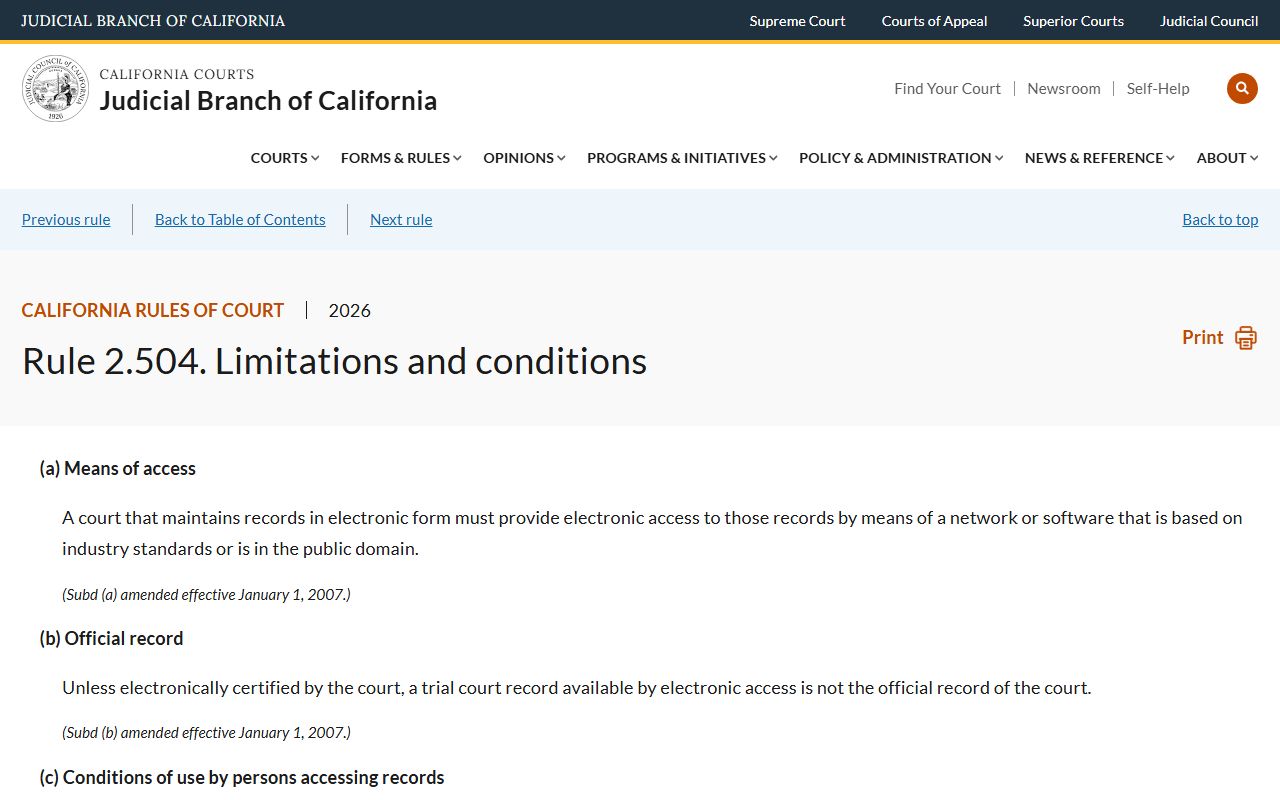
The rule keeps electronic records useful without making them official by default. That balance protects both access and accuracy.
Key Statutes and Rules:
California Rule of Court 2.503 - Defines what court records can be viewed remotely and what must be viewed at the courthouse.
California Rule of Court 2.504 - Says electronic court records are not official unless electronically certified by the court.
Government Code § 7920.000 - The recodified California Public Records Act governing state and local agency records.
Government Code § 7922.000 - Public-interest balancing test that can support withholding when privacy or operations outweigh disclosure.
Government Code § 7923.610 - Backs release of contemporaneous arrest and booking data for the past seven days.
Records That Are Restricted or Confidential
Not every court record is open. Juvenile case files are confidential under Welfare and Institutions Code section 827. Access is limited to the minor, parents, attorneys, probation, child welfare, law enforcement, and others named by law or court order. Juvenile sealing under Welfare and Institutions Code section 781 can restrict access even further. Adoption records are also confidential and need statutory authority or a court order before release.
Sealed records under California Rules of Court 2.550 and 2.551 are closed to the public unless the court orders otherwise. A party who wants access must usually file a motion or follow the procedure in the sealing order. Sealing can apply to one document or the whole case. Mental health and LPS conservatorship records are restricted by state privacy rules, and remote access is limited under the electronic-access rules.
Confidential marriage records under Family Code section 511 stay closed to the public. The County Clerk may confirm a record exists but cannot release the date without a court order, and certified copies go only to a spouse. Domestic violence files often have redacted addresses and minor information. Active law-enforcement investigations and grand jury proceedings are protected by separate statutes. To request access to a sealed record, talk to the clerk in the division that holds the file or get legal help first.
Specialty Courts in Solano County
Solano runs several specialty tracks through its Superior Court rather than as separate courts. The local rules cover mental health diversion procedures, with filings tied to diagnostic and treatment history and a prima facie suitability finding. Eligibility lines up with California Penal Code mental health diversion rules: qualifying mental disorder, link between disorder and offense, treatment plan, and no unreasonable risk to public safety. Drug and diversion calendars appear in criminal departments, including Department 11, where the court calendar lists Diversion Hearing entries.
Juvenile delinquency cases run under Welfare and Institutions Code section 602. Solano's juvenile presiding judge is Hon. Dora M. Rios, Department 16, Courtroom 101, at the Hall of Justice. In-custody juvenile transfer hearings happen Monday through Friday at 9:00 AM in Department 1. The court also lists Truancy Court within its juvenile navigation and partners with county agencies for placement and treatment options.
On the family side, the Family Law Facilitator and the Solano Legal Access Center are not specialty courts but they fill a specialized service role. They provide free help to self-represented people on family, restraining order, guardianship, and child support matters. The office is in Room 205 on the second floor of the Fairfield courthouse, with Monday-through-Thursday morning hours and a Friday window limited to domestic violence and elder abuse restraining order applications.
Solano County Sheriff and Jail
The Solano County Sheriff's Office runs custody, court security, civil process, and coroner services. Sheriff Brad DeWall was appointed September 26, 2025 after a long career in patrol, investigations, and custody. The main Sheriff office is at 530 Union Avenue, Suite 100, Fairfield, with a main line of (707) 784-7000 and 24-hour booking information at (707) 784-7112. The Records and Warrants Bureau is reached at (707) 784-7010. Lead-in for the screenshot: the Sheriff public-information hub groups the in-custody search, jail booking logs, Megan's Law, Most Wanted, and VINE in one place.
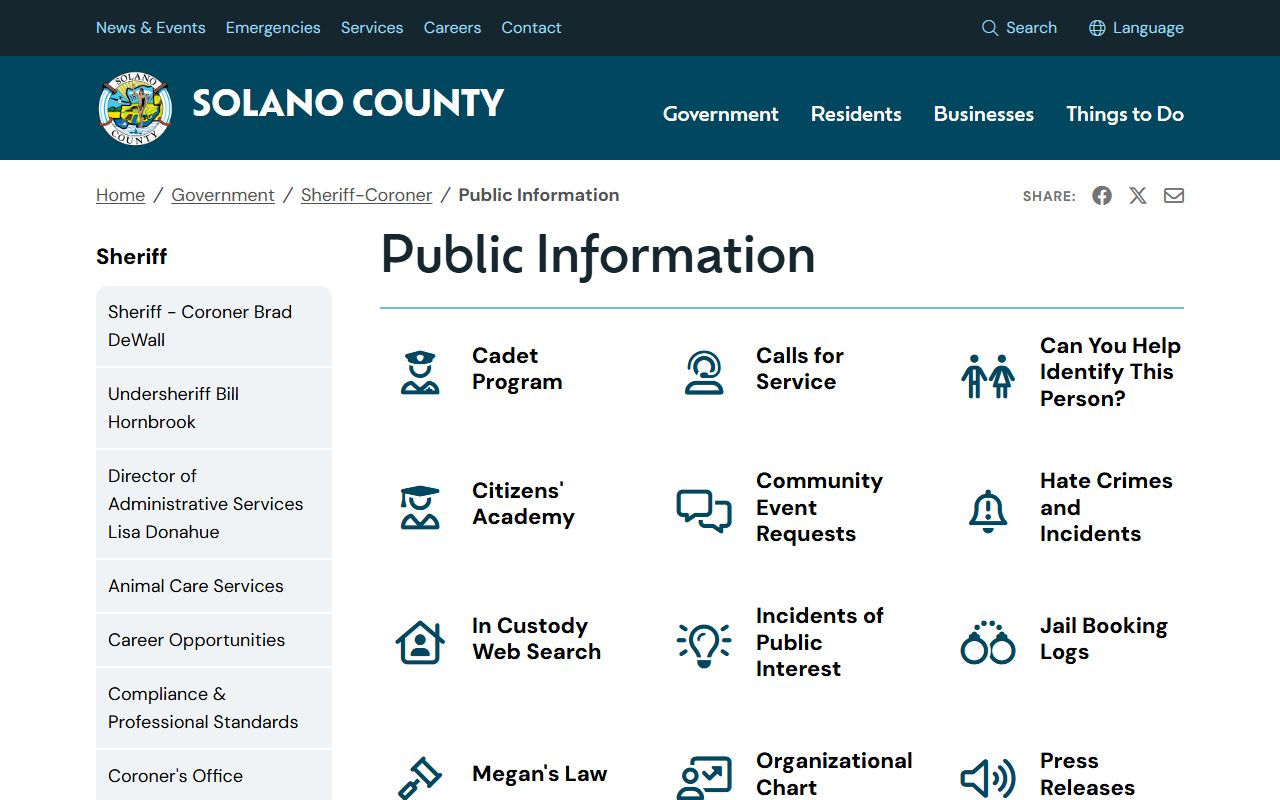
The hub is the right starting point for arrest, custody, and inmate questions. For a deeper dive, the site keeps separate pages for each tool.
The county runs three jail facilities: the Justice Center Detention Facility at 530 Union Avenue with a rated capacity of 712, the Stanton Correctional Facility at 2450 Claybank Road with 365 beds, and the Claybank Detention Facility at 2500 Claybank Road with 358 beds. Total rated capacity is 1,435. The in-custody search needs at least the first three letters of the first or last name. The jail booking logs page shows people arrested and booked in the past seven days, refreshed at midnight under Government Code 7923.610. For a full roster walkthrough, see the inmate records page. For active bench warrants tied to court cases, see the warrant records page.
Marriage, Divorce, and Probate Records
Marriage licenses are not court records. The Solano County Clerk at 675 Texas Street, Suite 1900, Fairfield, issues public and confidential marriage licenses; the application must be completed online before the office visit. Marriage certificates after the ceremony are handled by the Recorder and Vital Records Division at 675 Texas Street, Suite 2700, but only for licenses obtained in Solano County. Divorce judgments are court records, filed and copied through the Family Law Division at the Hall of Justice. See the marriage and divorce records page for the full process. Probate filings go through the Superior Court probate division. The probate records page walks through pre-grants, probate notes, and how to find a case.
- Testator
- A person who makes a will. The testator names beneficiaries and may name an executor to carry out the will.
- Executor
- The person named in a will to manage and close the estate. The court issues letters that give the executor legal authority.
- Conservator
- A person the court appoints to manage another adult's personal or financial affairs when that adult cannot manage them alone.
- Guardian
- A person the court appoints to care for a minor or to manage a minor's estate.
- Petitioner
- The person who files a petition starting a probate or family law case.
Solano County Court Records Fees
Court fees in Solano follow the Judicial Council statewide schedule for filings and the local schedule for copies, searches, and certified copies. The Vital Records office sets its own fees for birth, death, and marriage certificates. The fee table below pulls the rates that come up most often for record requests. For a full search, the court asks visitors to use Local Form 4021, Request for Record Search and Copies, and to pay assessed fees in advance.
| Item | Amount |
|---|---|
| Court record search longer than 10 minutes | $15 |
| Divorce judgment certified copy by mail | $15 |
| Non-certified divorce copies (per page) | $0.50 per page; check not to exceed $20 |
| Birth certificate (Solano-only births) | $34 |
| Death certificate (Solano-only deaths) | $26 |
| Marriage certificate (Solano-issued licenses) | $19 |
| Form 4021 request | Filed separately for each division; fees assessed in advance |
Make checks payable to Solano Superior Court for court records. Vital records checks go to the Recorder. Fee waivers are available for litigants who meet the court's financial hardship guidelines; the online services hub links the hardship application.
How to Interpret Solano County Court Records
A charge is not a conviction. An arrest, citation, or charging document only marks the start of a case. The disposition tells you what actually happened. Common dispositions include dismissal, plea of guilty or no contest, acquittal, conviction after trial, deferred entry of judgment, and diversion. A bench warrant entry does not mean a person is guilty; it usually means a hearing was missed. Always read the most recent minute order before drawing a conclusion.
Solano's calendar and case files use short codes. CL marks limited civil, including many collection cases. CU marks unlimited civil and some In the Matter of name-change filings. F and FCR mark felony and criminal cases. FL marks family law. FS marks family support and Department of Child Support Services cases. DPT is the department code, like DPT 7. OSC is Order to Show Cause. People v. is a criminal caption, while In re or In the Matter of is common in probate, name change, and certain family filings. A judge may also enter a "minute order" that summarizes what happened in court for a single hearing day.
If the record shows a sealing notation under Penal Code section 851.91 or a dismissal under Penal Code section 1203.4, the underlying case may still appear in court records, but its legal effect is different. A 1203.4 dismissal allows the defendant to withdraw a plea or set aside a verdict and have the accusation dismissed; it does not erase all records or restore firearm rights. Read the disposition language closely before relying on it.
Accuracy and Record Limitations
Solano's court homepage says case information is updated daily. Daily is not real time. A newly filed document may not appear until the clerk processes payment and access flags. A warrant recall, a bail change, or a same-day continuance can lag behind the live courtroom. Confidential cases never appear in public search at all. The Sheriff's in-custody search and booking logs carry their own disclaimers about completeness and accuracy.
Note: Always confirm key facts with the originating office before acting on online records. Call the clerk division, the Records and Warrants Bureau, or the 24-hour booking line at (707) 784-7112 for time-sensitive matters.
History of Solano Superior Court
Solano County is one of California's original counties, created at statehood in 1850. Fairfield is the county seat. The court system grew from county-level and limited-jurisdiction courts into the unified Superior Court model that California adopted county by county in the late 1990s and early 2000s. Today, one Superior Court handles every Solano trial matter from four facilities: the Hall of Justice and Law and Justice Center on Union Avenue, the Old Solano Courthouse on Texas Street, and the Solano Justice Building in Vallejo.
Recent technology milestones shape how people actually search records today. The public portal expanded access for specified parties and attorneys under California Rules of Court 2.515-2.523 on February 26, 2024. Probate notes were redeployed the same day. Mandatory attorney e-filing in civil, family, and probate cases under Local Rule 20 took effect January 2, 2025, and probate letters and bonds joined the e-filing list on April 1, 2025. These changes matter more for daily record access than the building dates.
Frequently Asked Questions
How do I search Solano County court records online?
Use the Solano Superior Court Public Portal. Register for a free account first, then click Case Search. The fastest path is an exact case number. If you do not have it, use Last Name, First Name, or Company Name with at least two characters, and narrow with a filing-date range when the name is common. Confidential cases and confidential documents do not appear in the public portal. For hearings only, the court calendar offers a separate keyword search that does not require an account.
Are online Solano court records official?
Not on their own. California Rule of Court 2.504 states that a trial court record available by electronic access is not the official record of the court unless electronically certified. Use the portal for research and status checks. When you need an official copy for employment, licensing, immigration, an appeal, or another legal filing, request a certified copy from the appropriate division during business hours and pay the certification fee.
What is the difference between the court, the County Clerk, and the Recorder?
Solano's Superior Court holds case files: civil, criminal, family, probate, juvenile, and traffic. The County Clerk at 675 Texas Street, Suite 1900 handles marriage licenses, fictitious business name filings, notary oaths, and similar registries. The Assessor and Recorder at 675 Texas Street, Suite 2700 handles recorded property documents, liens, maps, and Solano-only vital records. Sheriff custody, booking logs, and warrant information come from the Sheriff. Match the record type to the office before you go.
More on the Solano County Court Records FAQ page.