
California Has Superior Courts, Not District Courts
California runs a unified trial court model. Each of the 58 counties has one Superior Court, and that court handles every state trial matter in the county. There is no separate district court, justice court, county court at law, or stand alone probate court in the state system. Solano County fits this same pattern. The court here is called the Superior Court of California, County of Solano.
The unified model came out of court reform votes in the late 1990s. Before then, California had a split structure with municipal courts hearing lower civil claims and misdemeanors, and superior courts hearing felonies and larger civil cases. Counties voted to merge the two tiers under Proposition 220 in 1998. Solano completed unification along with the rest of the state by the early 2000s. Today one Superior Court covers it all.
Because the trial court is unified, jurisdiction is split into subject matter divisions and numbered departments inside the same court. A felony case, a divorce, a probate estate, and a small claims dispute are all filed in Solano Superior Court. Branch, division, and case prefix tell you where the actual file sits and which clerk window holds it. The court reports four court facilities, 23 judicial officers, and a staff of about 200 on its About the Court page.
The only real district court that matters for Solano residents is federal. The U.S. District Court for the Eastern District of California hears federal cases out of Sacramento, and Solano County is in its coverage area. That is a separate court system. Federal cases do not pass through the state Superior Court, and most local case work never touches federal court at all.
Solano Superior Court Jurisdiction
Solano Superior Court hears the full range of state trial matters. Criminal jurisdiction covers felony and misdemeanor prosecutions filed by the Solano County District Attorney or by grand jury indictment. Traffic infractions and certain misdemeanor traffic citations are handled inside the same court. Civil jurisdiction is split into three dollar tiers and covers contract, tort, collections, name change, and unlawful detainer cases.
Family law jurisdiction covers dissolution of marriage, legal separation, nullity, parentage, child custody, visitation, child support, spousal support, and domestic violence restraining orders. Probate jurisdiction covers decedents estates, wills, trusts, conservatorships, guardianships, and spousal property petitions. The court posts pre grants on selected probate matters and posts probate notes on all probate matters except guardianships and conservatorships.
Juvenile jurisdiction covers delinquency cases under Welfare and Institutions Code 602 and dependency cases for minors at risk. Most juvenile case files are confidential by statute. The court also hears guardianship and conservatorship matters, unlawful detainer evictions, and appeals from limited civil cases. The full list of case types is published by the court.
Some matters never come to state court. Federal crimes, federal civil cases, bankruptcy, and most federal agency disputes go to the U.S. District Court for the Eastern District of California or, for bankruptcy, the bankruptcy court for the same district. Workers comp cases go to the state Workers Compensation Appeals Board. Administrative license issues often start with state agencies before any court review.
Civil Dollar Thresholds in Solano County
Civil cases in Solano Superior Court fall into three tiers based on the dollar amount in dispute. The court's civil filing instructions page lists each tier. The dollar limits set the form set, the filing fee, the use of attorneys, the rules of evidence, and the path to appeal. Pick the wrong tier and the clerk will reject the filing.
| Civil Tier | Dollar Amount | Common Use | Attorneys |
|---|---|---|---|
| Small Claims | Under $12,500 (individual) | Minor debts, unpaid rent, return of deposits, simple consumer disputes | No attorneys at the first hearing |
| Limited Civil | Up to $35,000 | Collections, mid sized contract claims, vehicle damage, smaller personal injury | Attorneys allowed |
| Unlimited Civil | Over $35,000 | Larger personal injury, big contract suits, real property, complex tort | Attorneys allowed |
Small claims cases use simplified rules. Individuals can sue for up to $12,500 in small claims. Businesses and other entities are capped lower. There is no jury, and appeals go back into the Superior Court itself. Limited and unlimited civil cases use the standard Judicial Council forms, allow attorneys, and follow full Code of Civil Procedure rules. Unlawful detainer eviction cases follow their own fast track timing.
Court Facilities and Departments
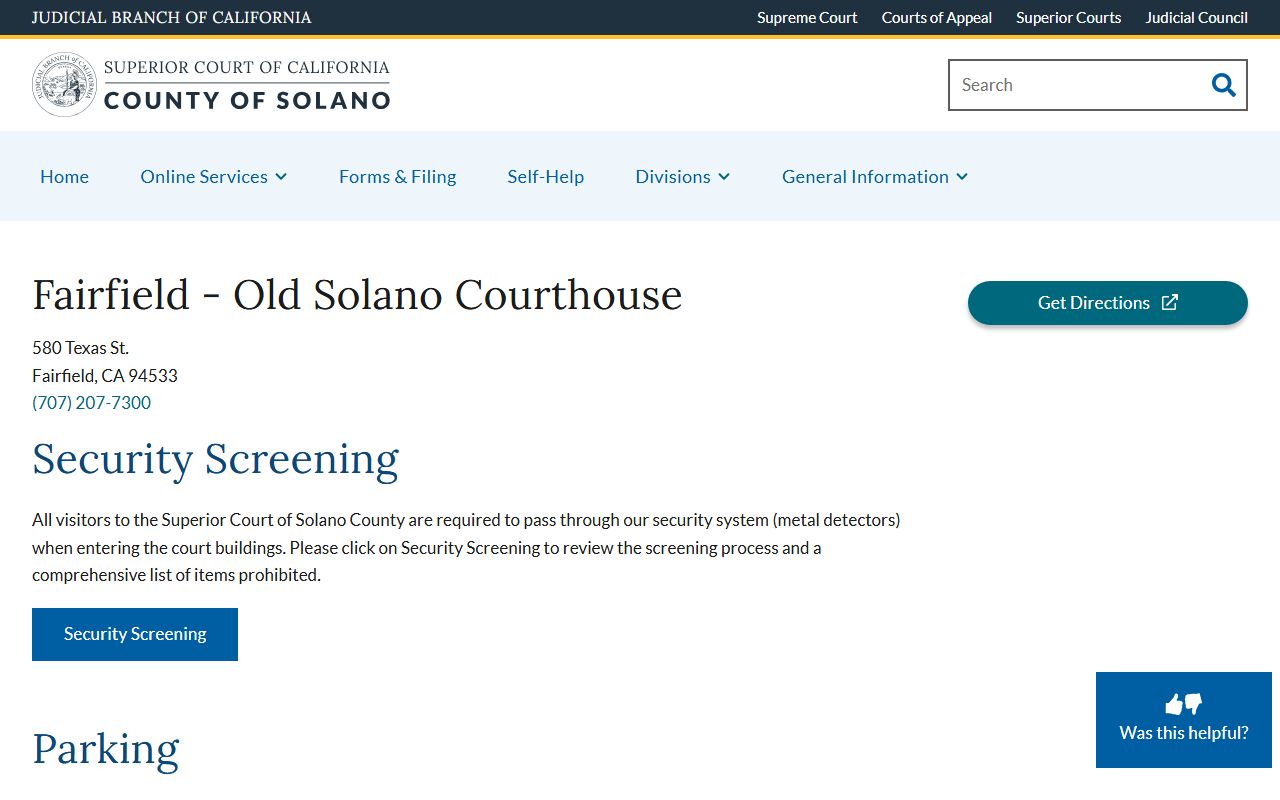
The Superior Court operates from four court facilities, three in Fairfield and one in Vallejo. The main public courthouse for most case types is the Hall of Justice on Union Avenue. The court's locations page lists hours, parking, security, and accessibility for each building.
| Facility | Address | Phone | What It Handles |
|---|---|---|---|
| Hall of Justice | 600 Union Avenue, Fairfield, CA 94533 | (707) 207-7373 | Main public courthouse; criminal, family law, juvenile presiding judge, public counter |
| Law and Justice Center | 530 Union Avenue, Fairfield, CA 94533 | (707) 207-7373 | Part of the Fairfield court campus; Union Avenue main entrance |
| Old Solano Courthouse | 580 Texas Street, Fairfield, CA 94533 | (707) 207-7300 | Civil services and the historic downtown courthouse setting |
| Solano Justice Building | 321 Tuolumne Street, Vallejo, CA 94590 | (707) 561-7800 | Vallejo branch; handles Vallejo and Benicia matters with case prefixes V/VC/VCR |
Court hours are 8 AM to 5 PM at the courthouse. Clerk offices take drop in customers 8 AM to 11:30 AM and serve appointments from 8 AM to 3 PM. The criminal record search window runs Monday to Friday, 8 AM to 3 PM, except for court holidays. Every visitor must clear metal detectors at the door.
The image below is the court's locations page, which lists each facility with parking and access notes.
Fairfield and Vallejo case files generally stay at the branch where the case was heard. Local case number prefixes are F, FC, FCR, and M for Fairfield, Suisun City, Vacaville, Dixon, and Rio Vista work, and V, VC, VCR, F, or M for Vallejo and Benicia work.
Numbered Departments Within the Court
Solano Superior Court uses numbered departments inside each facility. A department is a single courtroom and the judge or commissioner assigned to it. Some departments take only one case type. Others rotate. The list below shows departments that show up in the public court calendar and on court division pages.
| Department | Use / Judicial Officer | Location |
|---|---|---|
| Department 1 | Juvenile in custody transfer hearings; DA news references Department One for some criminal calendar work | Hall of Justice, Fairfield |
| Department 5 | Criminal calendar, including preliminary examinations | Fairfield court campus |
| Department 7 | Civil OSC hearings, long cause trials, and other civil matters | Fairfield court campus |
| Department 8 | Civil short cause trials and motion calendar | Fairfield court campus |
| Department 9 | Criminal preliminary examinations and jury trials | Fairfield court campus |
| Department 10 | Family Law, Hon. Christine Donovan, Courtroom 305 | Hall of Justice, Fairfield |
| Department 11 | Criminal diversion, placement, and arraignment hearings | Fairfield court campus |
| Department 12 | Criminal preliminary examinations | Fairfield court campus |
| Department 14 | Family law trials | Fairfield court campus |
| Department 16 | Juvenile Court Presiding Judge Hon. Dora M. Rios, Courtroom 101 | Hall of Justice, Fairfield |
| Department 18 | Family court trials | Fairfield court campus |
| Department 23 | Criminal motion calendar and trial management | Fairfield court campus |
Department numbers appear on every hearing notice as DPT 7 or similar. A case can move between departments as it progresses, since pre trial, trial, and post judgment work may be set in different courtrooms. Department setting guides held by the clerk show which department hears each type of motion. Always check the most recent hearing notice or the court calendar before showing up.
The Solano Court Hierarchy
A Solano state trial case starts at Superior Court. If a party appeals, the case moves up through the California appellate system. The path is short and clear.
State case path: Solano Superior Court › California Court of Appeal, First Appellate District › California Supreme Court
- Trial court: Solano Superior Court hears all general and limited state trial matters. Most cases end here.
- Intermediate appeal: The California Court of Appeal, First Appellate District, reviews appeals from Solano. The First District sits in San Francisco.
- Top state court: The California Supreme Court is the last resort for state law issues. It picks the cases it hears and turns most petitions down.
For limited civil and small claims, appeals do not leave the trial court at first. A small claims appeal is heard de novo by a different Superior Court judge. Limited civil appeals go to the appellate division of the same Superior Court. Felony appeals, unlimited civil appeals, family law appeals, and most other appeals go straight to the First District Court of Appeal.
Specialty and Juvenile Proceedings
Juvenile delinquency cases are filed under Welfare and Institutions Code 602. The statute covers any minor under 18 alleged to have violated a state or federal criminal law. Solano's juvenile delinquency calendar runs in Department 1 for transfer hearings and in Department 16 for the presiding judge. In custody transfer hearings are held Monday through Friday at 9 AM. Out of custody transfer in hearings sit Monday or Wednesday at 9 AM. The juvenile presiding judge is Hon. Dora M. Rios.
Most juvenile files are confidential by statute. Welfare and Institutions Code 827 limits access to specific persons such as the minor, parents or guardians, attorneys, probation, child welfare workers, law enforcement, and others named by law or by court order. The court's juvenile confidentiality page repeats these rules. Outsiders have to file a petition to inspect a juvenile case file and prove a legitimate interest.
The image below is the court's juvenile delinquency page.
The court runs other specialty tracks inside the criminal departments. Mental health diversion shows up under the local rules. Drug and treatment diversion hearings appear in the court calendar in Department 11 and other criminal departments. Family Law uses Child Custody Recommending Counseling and the Solano Legal Access Center as a self help arm. Veterans diversion exists under state law, though Solano has not been confirmed to run a dedicated stand alone Veterans Treatment Court.
Federal Eastern District Coverage
Federal cases from Solano County go to the U.S. District Court for the Eastern District of California. The Sacramento Division of the Eastern District is the venue that covers Solano. Federal civil rights cases, federal criminal prosecutions, federal habeas petitions, and most other federal cases out of Solano are filed there.
Federal appeals leave the Eastern District and go to the U.S. Court of Appeals for the Ninth Circuit. The Ninth Circuit sits primarily in San Francisco and Pasadena. State court appeals from Solano never go to the Ninth Circuit, except in narrow federal question paths after the state Supreme Court has acted.
Federal court records are public through PACER. Bankruptcy is a separate federal court for the Eastern District. None of this is part of the Solano County Superior Court system.
Local Rules and E-Filing
Solano operates under the Complete Solano Local Rules. The current rule set is effective July 1, 2025 and covers general, criminal, civil, family, juvenile, probate, appeals, unlawful detainer, guardianships, protective orders, court reporters, remote appearances, and electronic filing. Read the local rules before any non routine filing.
Attorney e-filing is mandatory in civil, family law, and probate matters as of January 2, 2025. The court e-filing page lists the approved vendors, the file formats, the size limits, and the steps for sealed or confidential filings. Self represented filers may still file on paper, although electronic filing through the same vendors is allowed. Probate letters and bonds joined the e-filing roster in late 2024.
Family law users see additional drop box rules and family law fee schedules on the family law forms page. Criminal users should look at the criminal court division page for the bail schedule, warrant rules, and arraignment procedures. Tentative rulings for civil law and motion appear in the court's daily tentative rulings list.
Judges and Court Leadership
The court runs with 23 judicial officers and a staff of about 200, per the About the Court page. Judicial officers include sitting judges and commissioners. Commissioners hear traffic, small claims, some family law, and other matters where parties consent. Each judge or commissioner is assigned to a department and may rotate between assignments by court order.
Identified judges in published court materials include Hon. Christine Donovan in Department 10 for Family Law and Hon. Dora M. Rios in Department 16 as Juvenile Court Presiding Judge. The current presiding judge of the full court and the assistant presiding judge can change by election within the bench. See the court's About page for current leadership and any change in presiding judge.
The court is supported by the Court Executive Officer, the Court Clerk's office, the Solano Legal Access Center, family law facilitators, probate examiners, and the court reporters' office. Each division has its own clerk supervisors and contact lines. Court administration's general line is (707) 207-7373.
How to Search Solano Superior Court Cases
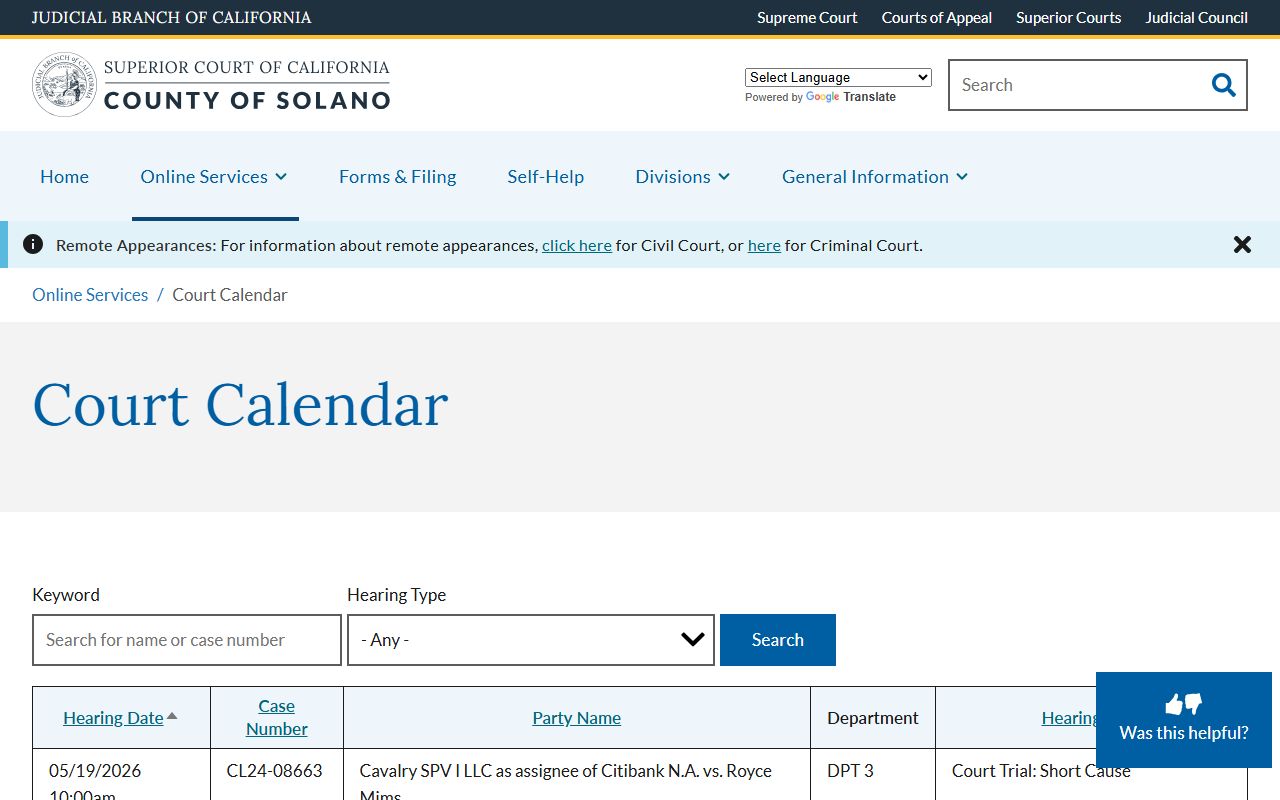
The public can search court case data through the Solano Superior Court Public Portal. Free account sign up is required to view case detail. The court also offers a public court calendar with no login. For deeper guides on searching, paying citations, or pulling certified copies, see court records, court dockets, and Clerk of the Superior Court.
The image below is the court's official court calendar, which is one of the few search tools that runs without an account.
- Open the public portal home page and click Register if you do not have an account.
- Fill in email, password, name, and phone, then agree to the terms of use.
- Click Case Search after login. Use the case number for the most exact match.
- Without a case number, use a last name with at least two letters, then narrow by filing date range.
- For hearing dates only, skip the portal and use the public court calendar by keyword and hearing type.
Confidential cases, juvenile files, sealed cases, and confidential marriage cases do not show on the public portal. For those, file the right access petition or request through the clerk under Local Form 4021. Older case files and certified copies still come from the clerk in person, by mail, or through the appointment system.
Frequently Asked Questions
Q: Does Solano County have a district court?
A: Not in the state system. California uses one Superior Court per county for all state trial matters. The only district court that touches Solano is the federal U.S. District Court for the Eastern District of California. Local felonies, divorces, traffic tickets, and probate cases all go to the Solano Superior Court, not a district court.
Q: How are Solano departments different from divisions?
A: A division is a subject matter unit, such as Criminal, Civil, Family Law, Probate, or Juvenile. A department is a single courtroom with one judge or commissioner. One division can have many departments, and one department can hear matters from more than one division depending on the rotation.
Q: Where do appeals from Solano Superior Court go?
A: Most state appeals from Solano go to the California Court of Appeal, First Appellate District in San Francisco. The California Supreme Court is the last step, but it hears only a small share of petitions. Small claims and limited civil appeals stay inside the Superior Court at first. See FAQ for more.