
How to Find Recently Released Solano County Inmates
Solano does not publish a "released within the last 30 days" list. Instead, you piece a release together by checking the live custody roster, the booking logs, and the 24-hour booking line. A name that was on the roster yesterday and is gone today often means a release, but it can also mean a transfer, a court order, or a record mismatch. The Sheriff's own disclaimer says the locator is not an official record and may leave some inmates out.
Start with the Sheriff in-custody search. The page asks for at least the first three letters of a first or last name. Then check the jail booking logs for the past week. The booking logs page covers people arrested and booked into the county jail within the last seven days, refreshed at midnight under Government Code 7923.610. The image below shows the Sheriff custody search form.
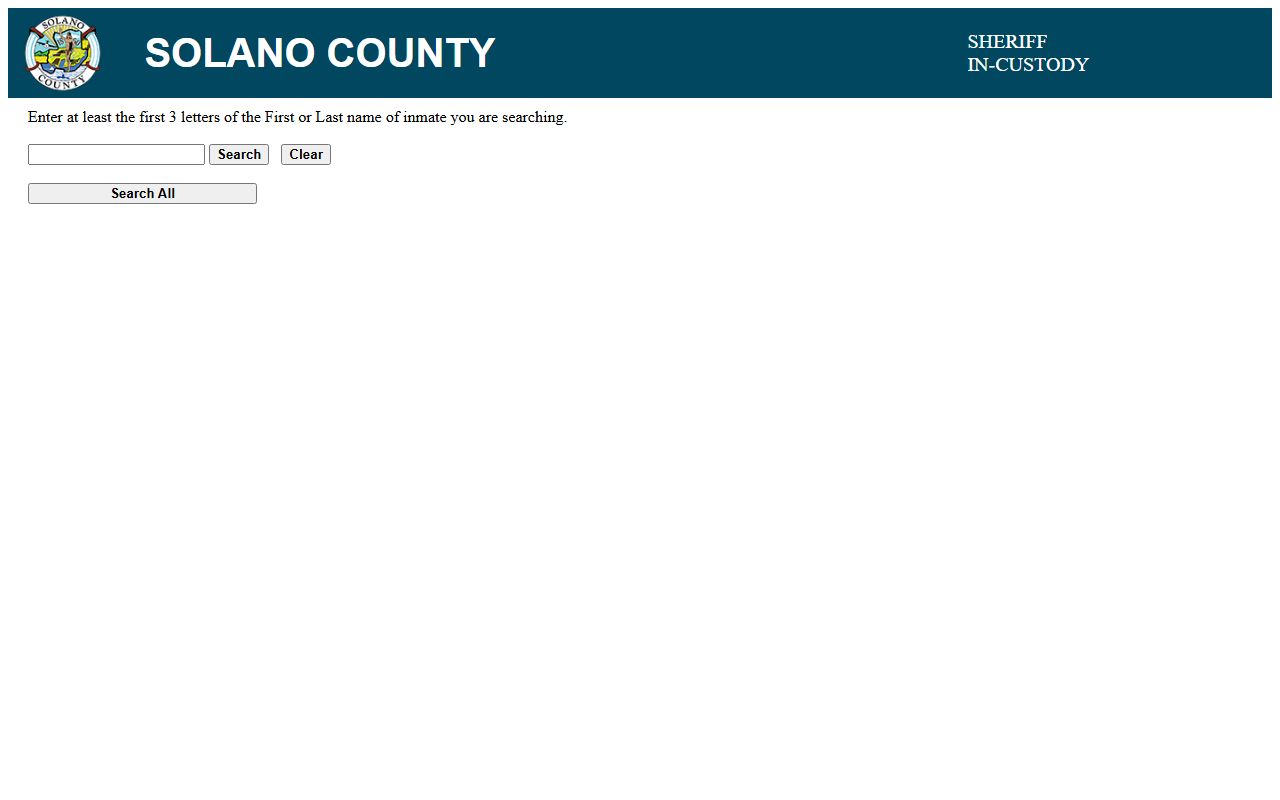
If the name does not turn up on either tool, call the 24-hour booking information line for status confirmation.
- Open the Solano Sheriff in-custody search and type at least three letters of the first or last name. Click Search.
- If the person is no longer in custody, open the Jail Booking Logs and look through the most recent 24-hour periods.
- Note any matching booking number, charges, and the booking date listed.
- Call the 24-hour booking information line at (707) 784-7112 to confirm whether the person was released, transferred, or is still on a hold.
- If the case ended in a state prison sentence, move to the CDCR CIRIS search for current state custody or release status.
- For federal cases, run the Federal Bureau of Prisons locator. Federal cases never appear on the county roster.
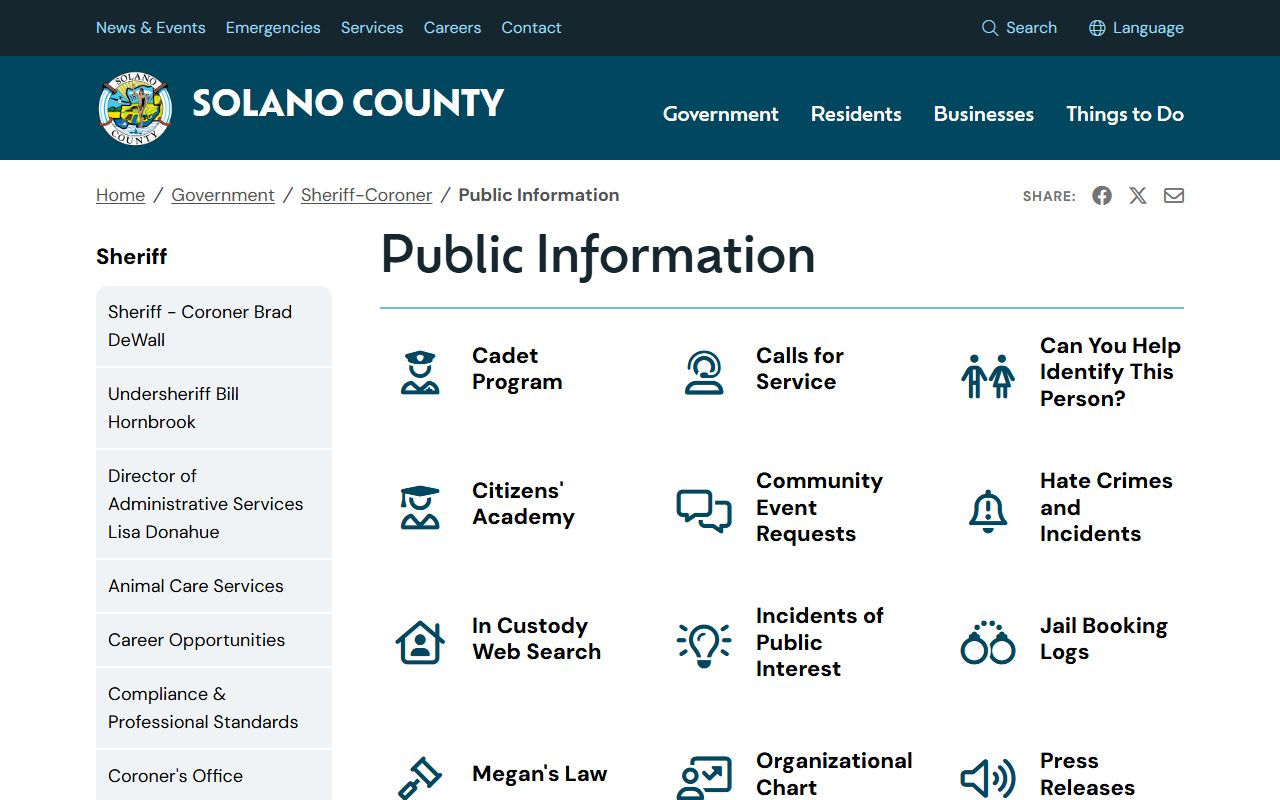
The Sheriff's public information page ties all of these tools together in one spot. The same page links to Megan's Law, Most Wanted, and the VINE notification site. Disable popup blockers before you click the booking logs link, because the report opens in a new window.
Setting Up Release Notifications with VINELink
VINELink is the public, web version of the VINE (Victim Information and Notification Everyday) system. California uses it statewide for jail and prison custody updates. Anyone can register, not just registered victims. You enter a state and a name or ID, and the site emails, calls, or texts you when the person is booked, moved, released, or has a hearing change. The image below shows the VINELink home page used for Solano County lookups.
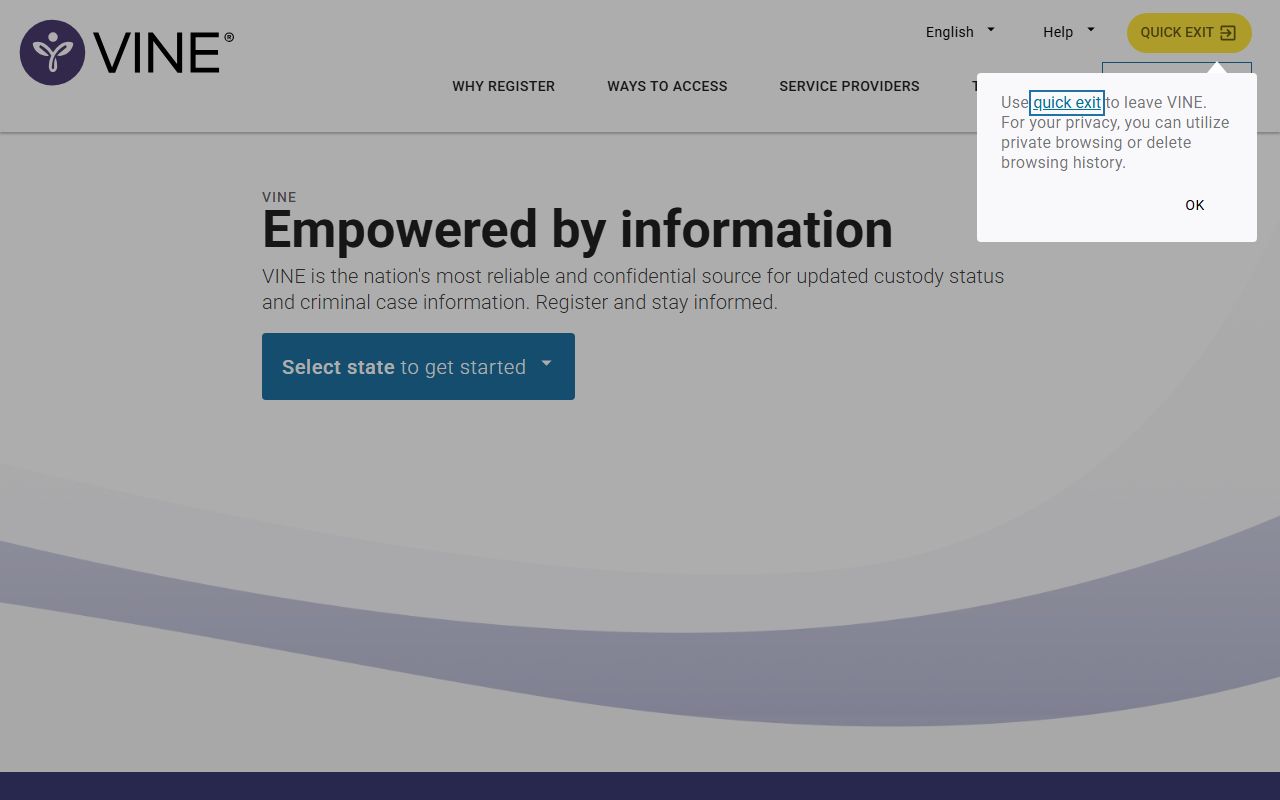
Solano County feeds its jail data into VINE through the Sheriff's Office. The service is free. Notifications are anonymous on the inmate side, so the person being tracked never knows you signed up. Set up takes a few minutes and works for any California jail or state prison that posts to VINE.
- Open VINELink and pick California from the state list or map.
- Choose Offender Search and enter a last name, first name, or known ID number. The site pulls a list of matching records.
- Click the matching record to view current custody status, facility, and case data.
- Click Register for Notifications and enter a phone, email, or both. Set a four-digit PIN to confirm phone alerts.
- Confirm the alert types you want, such as release, transfer, court hearing, or escape.
- Save the registration and watch for a test message. You can edit or cancel alerts at any time.
Heads up. VINE alerts depend on data fed by each county jail or state prison. The notice can be delayed by minutes or a few hours, and a missed alert can happen if the source system fails. Do not rely on VINE as your only safety plan if release timing matters for protection.
The same VINELink account can track more than one person at the same time. Out-of-state cases work too, so a Solano victim who is also tracking a Nevada or Oregon inmate can manage all alerts in one place.
Searching State Released Inmates Through CDCR CIRIS
If a Solano case ended in a state prison sentence, custody moves to the California Department of Corrections and Rehabilitation. CDCR runs the public search called the California Incarcerated Records and Information Search, or CIRIS. The tool covers people currently in CDCR custody, on active parole, or out on a discharge that is still recent enough to be in the public file. The image below shows the CIRIS search page.
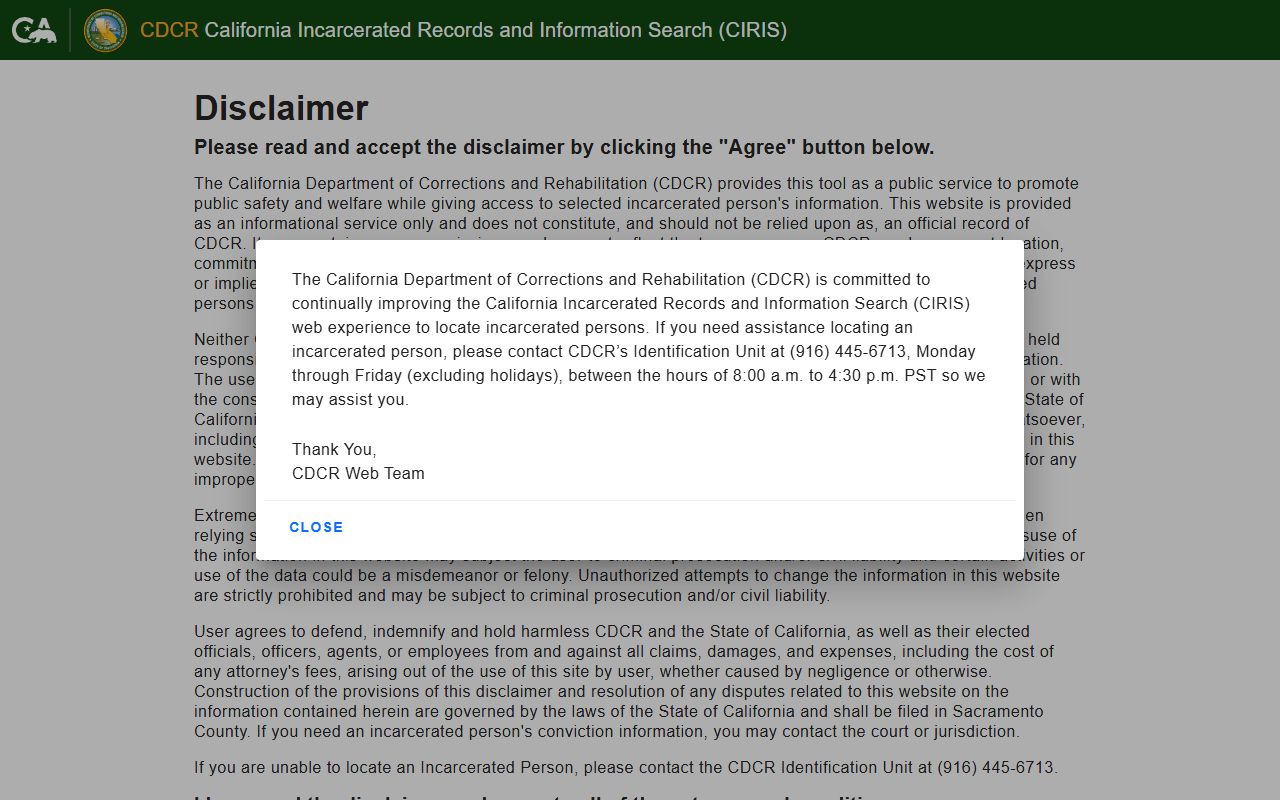
CIRIS is free and open to the public. You can search by name or by CDCR number. The CDCR number is the unique ID the state assigns at intake, and it stays with the person across moves. The fields below match what the public search asks for.
| Field | Type | Required | Notes |
|---|---|---|---|
| Last Name | Text | Yes for name search | Use the legal last name. Common names return many hits. |
| First Name | Text | Optional | Narrows results. Middle name and aliases may also help. |
| CDC Number | Text | Optional | Direct ID search. Format is a letter followed by digits. |
| DOB / Age | Date or number | Optional | Helps when many people share the same name. |
Open CIRIS at ciris.mt.cdcr.ca.gov to start. The result page shows current location, admission date, controlling sentence, and parole eligibility data when available. Released-on-parole status will show the parole region rather than a prison. Discharged people may show a recent release date and then drop off public view once the file ages out.
Victims can also sign up for direct alerts through the CDCR Office of Victim and Survivor Rights and Services. That program runs alongside VINE and may give earlier notice of parole hearings.
Federal Released Inmates and the BOP Locator
Federal cases out of Solano County run through the U.S. District Court for the Eastern District of California. People sentenced to federal time go into the Federal Bureau of Prisons, not CDCR. The BOP has its own public locator that covers current federal inmates and people released since 1982. Solano residents who served a federal sentence will show up there, not on the county or state tools.
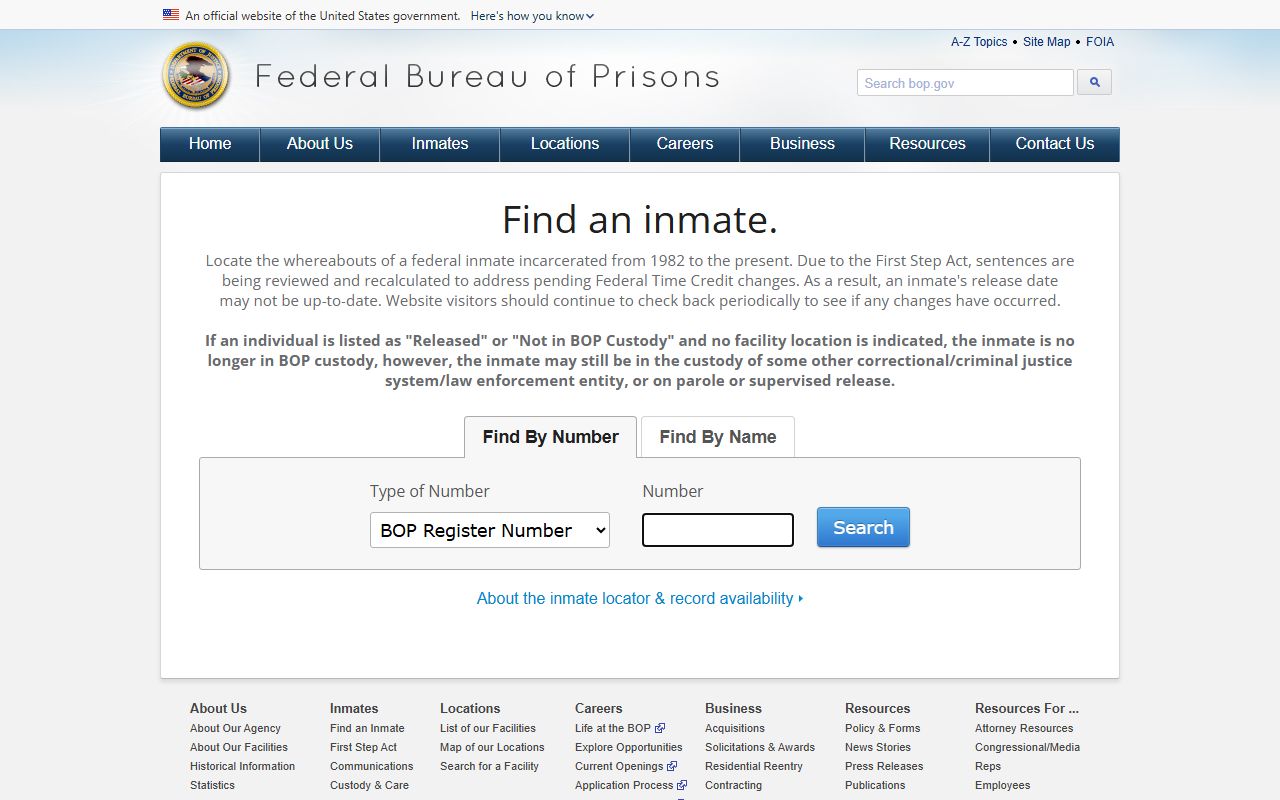
The locator at bop.gov/inmateloc takes either a register number or a name. The fields below list what the search form accepts.
| Field | Type | Required | Notes |
|---|---|---|---|
| BOP Register Number | Text | For number search | Eight-digit ID assigned at federal intake. Most direct match. |
| Last Name | Text | For name search | Legal last name. Aliases may not match. |
| First Name | Text | For name search | Use full first name when known. |
| Age | Number | Optional | Helpful filter for common names. |
| Race | Dropdown | Optional | BOP demographic category. |
| Sex | Dropdown | Optional | Male or Female options. |
Results show the federal register number, age, race, sex, and current facility or release date. For people who are out, the release date and the prior facility appear, but the home address is never shown. For active cases tied to PACER, see the Solano court records page for a federal court overview. Solano sits inside the Ninth Circuit on appeal, so federal appeal records can also touch local cases.
The California Sex Offender Registry
People released from prison or jail after a sex-offense conviction may be required to register under California law. The public-facing registry is run by the California Department of Justice and is known as Megan's Law. The site at meganslaw.ca.gov lets the public look up registered offenders by name, by city or ZIP, and by offense category. Not every registrant is publicly displayed. Some are exempt by statute or court order. The image below shows the Megan's Law landing page.
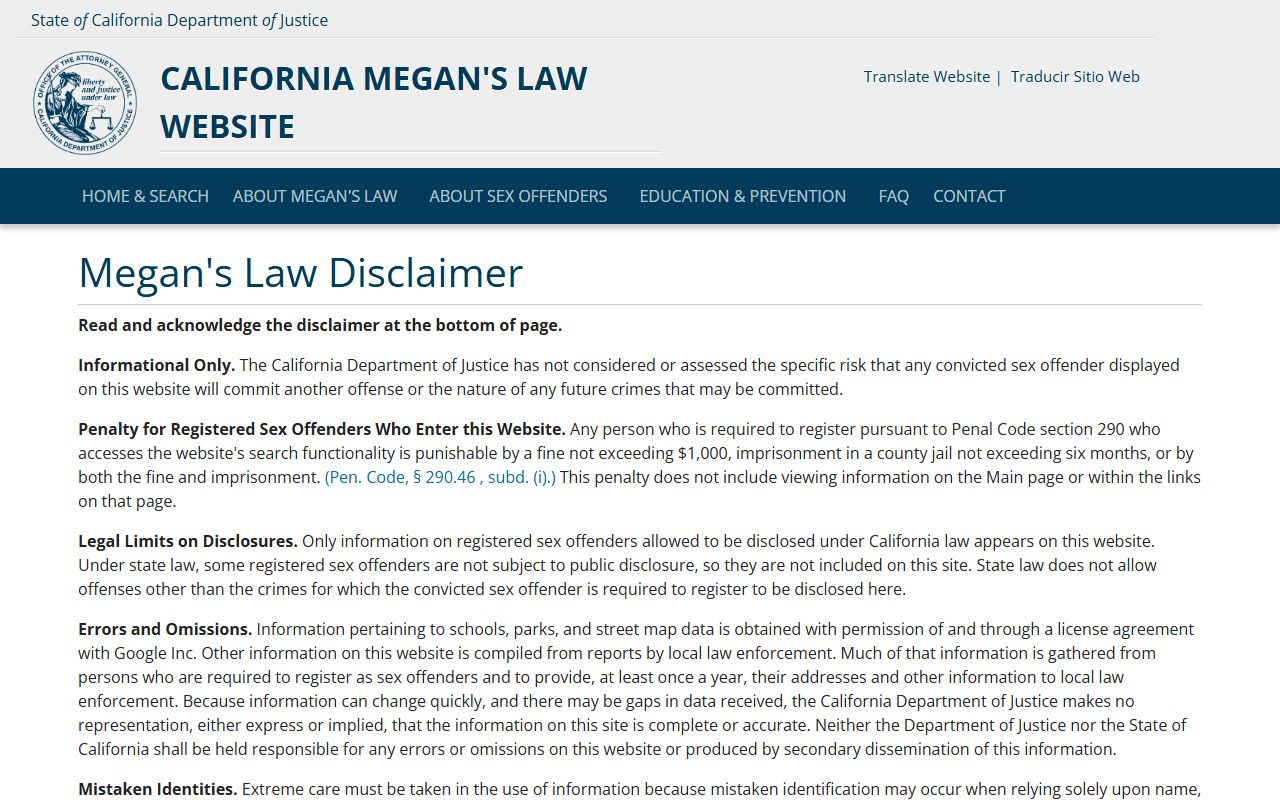
You must accept the public-use disclaimer before any search runs. Misuse of registry data, such as for harassment or to deny housing or jobs in ways not allowed by law, is a crime. The fields below match what the public search asks for.
| Field | Type | Required | Notes |
|---|---|---|---|
| Last Name | Text | Optional | Begins-with or exact match. |
| First Name | Text | Optional | Narrows large result sets. |
| City | Text | Optional | Solano cities such as Fairfield, Vallejo, Vacaville. |
| ZIP Code | Text | Optional | Search by ZIP and an optional radius. |
| Offense Category | Dropdown | Optional | Filter by offense type or risk display tier. |
Each match opens a public profile. The profile usually shows the fields below, though display rules vary based on offense and tier.
- Name and aliases. Legal name and any registered alias.
- Photo. Current registration photo on file.
- Date of birth or year. Year or full DOB based on display rules.
- Last known address. Street address, city, ZIP, or "transient" when allowed.
- Registered offense. Code section and short title.
- Compliance status. Whether the person is in compliance with registration duties.
- Physical description. Sex, race, age, height, weight, hair, eyes, plus any scars or tattoos.
Open meganslaw.ca.gov to start. Solano County also links to the registry from the Sheriff's public information page, which is a useful one-click entry point.
Parole and Probation Information
People released from state prison in California are usually supervised by CDCR's Division of Adult Parole Operations. Parole conditions are set by CDCR and the Board of Parole Hearings. Conditions can include a curfew, search clauses, no-contact orders, GPS, and reporting to a parole agent. A parole violation can result in a return to custody. Victims can request notice of parole hearings through the CDCR victim services office.
People sentenced in Solano Superior Court to a county jail term or to probation are supervised by the Solano County Probation Department, not CDCR. Probation officers run pre-sentence reports, set up supervised release plans, and monitor compliance for both adult and juvenile cases. Probation violations come back to the Solano Superior Court, often as a no-bail bench warrant. For active warrants tied to a violation, see the Solano warrant records page.
California Department of Corrections and Rehabilitation
Office of Victim and Survivor Rights and Services
P.O. Box 942883
Sacramento, CA 94283-0001
Victim notification: 1-877-256-6877
CIRIS search: ciris.mt.cdcr.ca.gov
For local case files that mention probation, parole, or post-release community supervision, the underlying court file is on the Solano Superior Court public portal. The docket will list violation hearings, modifications, and any new bench warrants.
Verifying Release in Person or By Phone
Public databases lag. A phone call to the right desk often beats a click in this situation. The Sheriff runs a 24-hour booking information line that confirms custody status. For paper proof of a release, the Records and Warrants Bureau in Fairfield handles records requests during business hours. Bring a photo ID and the inmate's full name and date of birth when you visit in person.
Phone lines that help with release questions in Solano County are listed below.
- 24-hour booking information. (707) 784-7112. Status confirmation for any person booked at the county jail.
- Sheriff main line. (707) 784-7000. General Sheriff's Office switchboard at 530 Union Avenue, Fairfield.
- Records and Warrants Bureau. (707) 784-7010. Records requests and warrant verification.
- Non-emergency dispatch. (707) 421-7090. Used when public safety is at stake but not an active emergency.
For in-person visits, the Sheriff's main office and the Records and Warrants Bureau sit at the Justice Center Detention Facility, 530 Union Avenue, Suite 100, Fairfield, CA 94533. The image below shows the Sheriff public information page that organizes these tools.
Bring a valid government photo ID. Family members asking for release-day pickup of property may need to show a relationship or a power of attorney. Some property is held at a separate facility, so call before you drive over.
Reentry Resources in Solano County
People coming out of jail or prison often need help with housing, mental health care, substance use treatment, jobs, and ID documents. Solano County Health and Social Services runs the main county-level door for those services. CDCR provides reentry support for state prison releases through its Division of Rehabilitative Programs. Federal releases get help through BOP residential reentry centers.
Local and state contacts that come up most often for Solano reentry needs are listed below.
- Solano County Mental Health Managed Care. (800) 547-0495. County mental health access line.
- Solano County Substance Abuse Services. (707) 784-2220. Treatment access and referrals.
- Solano Legal Access Center. Free help for self-represented users in family, restraining order, elder abuse, and child support matters.
- CDCR reentry programs. State-prison release planning, transitional housing, and parole resource centers.
- California EDD. Job search support and unemployment claim help after release.
The court's Superior Court website lists self-help resources for people who handle their own legal cases after release. For criminal-history questions and dismissal options, see the Solano criminal records page. For court schedules tied to post-release hearings, see the court records page.
Civil Rights Restoration After Release in California
California restores most civil rights at or shortly after release. The rules are different for voting, jury duty, firearm rights, and employment. Knowing what comes back, and when, helps a former inmate avoid new charges and rebuild a normal life.
Voting rights. Under Article II, Section 4 of the California Constitution, voting rights are restored as soon as a person is released from state or federal prison. Parole and probation status no longer bars voting in California. A person on parole, probation, mandatory supervision, or post-release community supervision can register and vote. People still inside a state or federal prison for a felony cannot vote.
Dismissal relief under Penal Code 1203.4. Many people with a Solano conviction can ask the court to dismiss the case after they finish probation. Penal Code section 1203.4 lets an eligible person withdraw a plea or set aside a verdict and have the accusation dismissed. It is sometimes called "expungement," but it does not erase every record. The court file still exists, and some agencies can still see the case. Filing is done in the court of conviction, usually with Judicial Council forms.
Firearm rights. A 1203.4 dismissal does not restore the right to own or buy a gun. Felony convictions and many domestic violence misdemeanors trigger a lifetime firearm ban under Penal Code 29800. Some convictions also carry a 10-year ban. A pardon from the Governor is one of the few ways to lift the felony ban, and that process is long.
Employment and licensing. California's Fair Chance Act limits when an employer can ask about a conviction. Many state licensing boards must consider rehabilitation. Background checks for jobs, housing, and licenses run through the California Department of Justice and the FBI, not the county jail. The county clerk does not run rap sheets.
Note. Records that show release status reflect the data fed by the agency that held the person. Errors, late updates, and excluded entries do happen. Treat any "release confirmed" answer from a public website as a lead, not as proof. For decisions that matter, verify with the Sheriff, CDCR, or the BOP by phone or in writing.
Frequently Asked Questions
Three short answers cover the questions that come up most often around Solano release lookups.
When during the day does the Solano County jail release people? There is no fixed release hour. Sentenced inmates and people cleared by court order can leave at any time of day or night, often after paperwork, property return, and medical clearance are done. The 24-hour booking information line at (707) 784-7112 can give a current status. Plan for delays of several hours after a court order is signed.
Are released-inmate records confidential? Most basic custody information is public under the California Public Records Act, including the name of the person, the booking date, charges at booking, and release dates. Some details, such as medical or mental health data, are confidential. Juvenile release information is restricted under Welfare and Institutions Code 827. Sealed cases and cases under court order may not show in the public tools.
Who can be notified of a release? Anyone who signs up through VINELink can get free alerts. Registered crime victims also have a right to notice through CDCR's Office of Victim and Survivor Rights and Services for state-prison cases. Family members can call the booking line directly. Attorneys often have their own access through court counsel or the Sheriff's legal calls line.
For broader background on inmate data, see the Solano County inmate records page. For aggregate facility numbers and bed counts, see the inmate population page. The Clerk of the Superior Court can answer questions about court paperwork tied to a release.