
How to Search Solano County Probate Records
The main tool for probate case lookups is the Solano Superior Court Public Portal. The portal lets the public search case data and gives parties on a case an enhanced view of the court's case management file. Most case searches need a free account. The portal sits next to the broader court online services menu, which also links to clerk appointments, the court calendar, citation pay, and tentative rulings. Confidential probate matters, sealed files, and mental health conservatorship records do not appear on the public portal.
Before logging in, gather a case number if you have one. If you only have a name, the last name field needs at least two letters. The portal will not run a one-letter wildcard. A filing date range helps narrow common names. Probate pre-grant orders and probate notes for upcoming hearings post on a separate page at the court's Probate Pre-Grants and Notes board.
The image below shows the official Probate Pre-Grants and Notes page, which is the entry point for posted notes and pre-grant rulings.
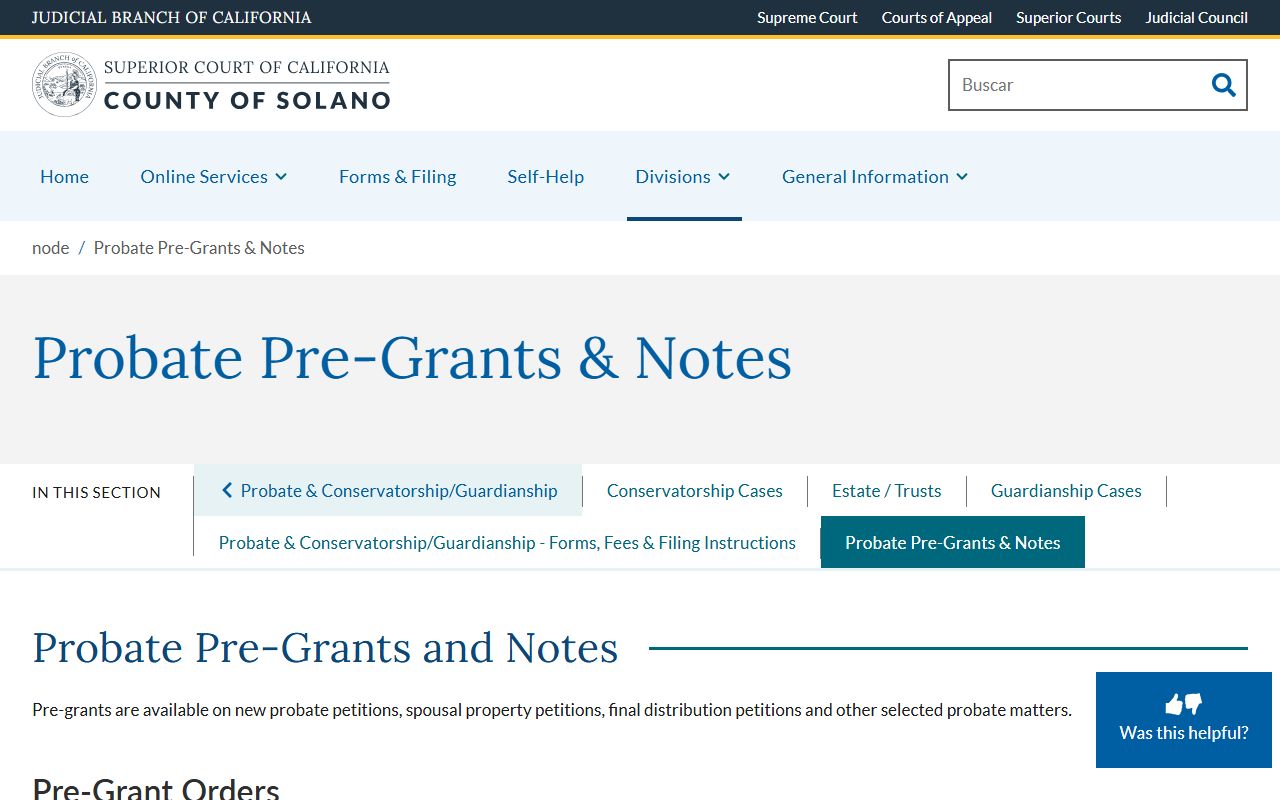
The steps below outline the basic search flow from registration to result review.
- Go to portal.solano.courts.ca.gov and click Register if you do not yet have an account.
- Fill in email, password, name, and phone. Required fields show a red asterisk.
- Check the terms of use box, then click Create New Account.
- After login, the site sends you to the User Home Page. Click Case Search.
- Enter a case number for the most exact result, or use a last name with two or more letters.
- Use the filing date range to cut down long name lists for common surnames.
- Click Search and open the case row that matches your decedent, ward, conservatee, or trust.
- Review the docket, hearing list, and any documents the portal shows on the case page.
- To check posted probate notes or a pre-grant order, open the Probate Pre-Grants and Notes page and find the hearing date.
- For certified copies, file Local Form 4021 with the Clerk of the Superior Court.
The Probate Division of Solano Superior Court
Probate Court is not a separate court in California. It is a division of the Superior Court. In Solano County, probate hearings sit on the calendar at the Hall of Justice in Fairfield, the same campus that handles civil and family matters. The probate division covers decedents' estates, wills, trusts, spousal property petitions, conservatorships, guardianships, final distributions, and related petitions. Probate, family, and adoption appointments share the same scheduling system at the Hall of Justice. The court lets customers book a time slot to file documents without waiting in line.
Walk-ins and appointments are limited to 30 minutes. New conservatorships and guardianships get extra time because the files are larger. Documents must be ready before the appointment. The clerk cannot prepare forms or give legal advice. People who need help are sent to the court's Self Help Center.
Probate Division, Solano Superior Court
Hall of Justice
600 Union Avenue
Fairfield, CA 94533
(707) 207-7373
Courthouse hours 8 AM-5 PM. Clerk drop-in 8-11:30 AM, by appointment 8 AM-3 PM.
Self Help: (707) 207-7355, flf@solano.courts.ca.gov
Case types in the probate division include probate of will, letters testamentary, letters of administration, spousal property petitions, trust petitions, conservatorship of person and estate, and guardianship of person and estate. The court's About page describes Solano Superior Court as the unified trial court of general and limited jurisdiction. That means the same Superior Court handles probate, civil, family, criminal, and traffic matters across the Fairfield and Vallejo branches.
Probate Notes and Pre-Grants
Solano runs a probate notes and pre-grant system that many other counties do not match. Pre-grant orders are the court's intended rulings on petitions, motions, and other matters set for hearing. The court posts pre-grants the court day before the hearing after 2 PM. Pre-grants cover new probate petitions, spousal property petitions, final distribution petitions, and other selected probate matters. Pre-grants are not posted for guardianships or conservatorships.
Probate notes are different. The court re-deployed notes on February 26, 2024. Probate staff prepare them after reviewing each petition, motion, or filing set for hearing. Notes post on all probate matters except guardianships and conservatorships. They flag defects so parties can fix them before the hearing date. Notes are not the final ruling, but clearing them often lets a party avoid an appearance. Notes are usually posted about one week before the hearing.
Defects are cleared by filing the right documents through normal channels. Attachments cannot be emailed to court staff. Use e-filing or in-person filing instead. A party must appear when the matter is contested, when proof of a holographic will is required and not yet given, when the petition concerns court confirmation of a property sale, or when the pre-grant order says to appear. The full board sits at the Solano Superior Court Probate Pre-Grants and Notes page.
What a Solano County Probate Record Contains
Probate files run long. A typical estate case stays open for a year or more. The table below shows the main field types found in a Solano probate record and what each one tells you.
| Field | What It Shows |
|---|---|
| Case Number | Local probate case ID. Used to pull the case in the portal and on Form 4021. |
| Decedent Name | The name of the person whose estate is in probate, or the ward, conservatee, or trust. |
| Petitioner | The person who filed the case. Often a surviving spouse, adult child, executor, or trustee. |
| Filing Date | The date the case opened. Used to narrow portal searches by date range. |
| Notices | Proof of notice to heirs, beneficiaries, and creditors. Proof of publication if needed. |
| Inventories and Appraisals | The court-approved list of estate property and its value, signed by the probate referee. |
| Letters | Letters testamentary or letters of administration giving the personal representative legal authority. |
| Bonds | The surety bond posted by the personal representative when bond is required. |
| Accountings | Periodic reports of receipts, disbursements, gains, and losses while the estate is open. |
| Orders | Court orders on petitions, sale confirmations, fees, and discharge. |
| Final Distribution | The order ending the estate and directing transfer of remaining property to heirs or beneficiaries. |
Hearing date, time, and department also show on the case page. Attorney name and bar number are common. Confidential documents and sealed attachments are blocked on the public portal under California Rules of Court 2.503 and 2.504.
Filing a Probate Case
Most probate filings start with a Judicial Council form, often paired with a Solano local form. The filing fee for a first probate petition is set by state statute and is usually paid when the case opens. Bond, certification, and publication add cost as the case moves.
Attorneys must e-file civil, family, and probate filings effective January 2, 2025 under the court's local rule. The mandate is described on the Solano electronic filing page. Self-represented parties may e-file by choice, drop off documents, or set a clerk appointment. The court added e-filing for probate letters and bonds on April 1, 2025. See the news item, Electronic Filing Now Available for Probate Letters and Bonds, for the detail.
The image below shows the Solano court online services landing page used for e-filing, clerk appointments, and case search.
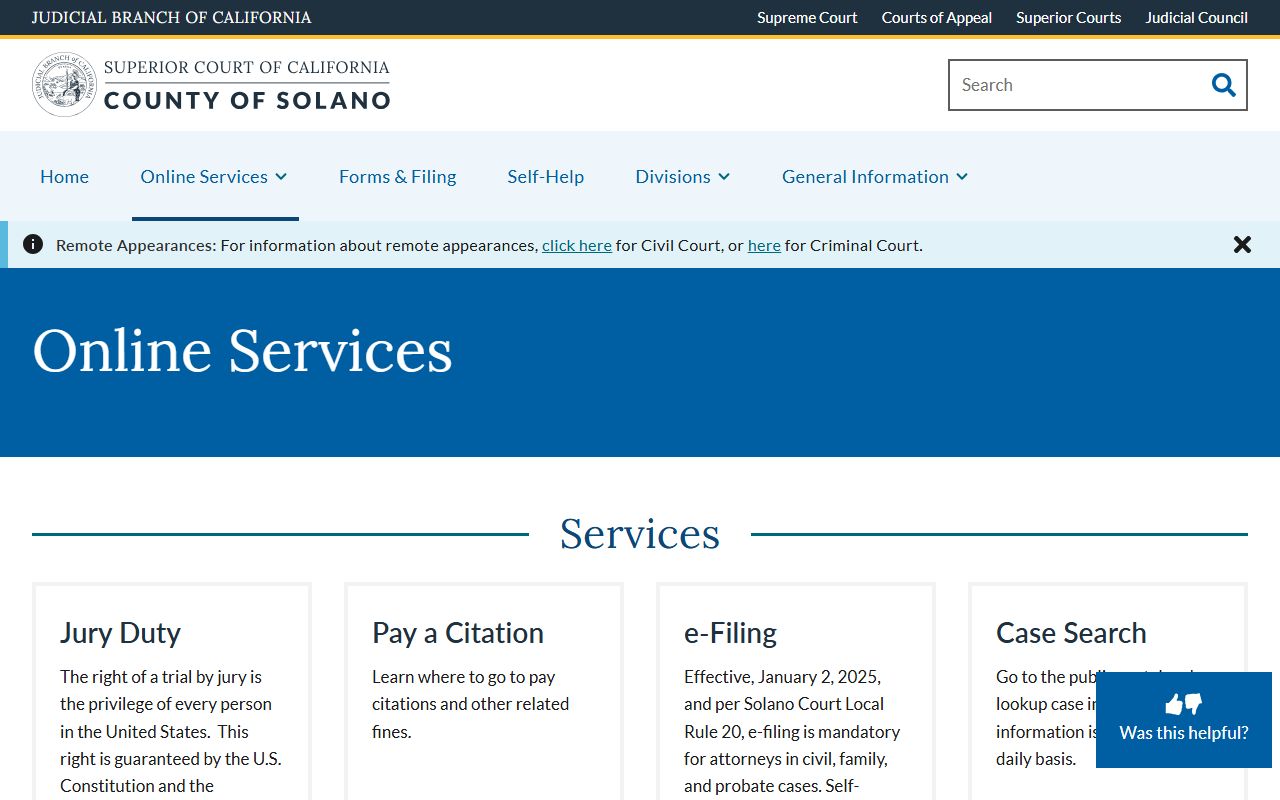
Fee waivers are available for people who qualify under California's financial hardship rules. The clerk takes a check or money order made payable to Solano Superior Court. Cash policies vary by branch, so call ahead.
Small Estates and Spousal Property Petitions
Not every estate needs a full probate. California Probate Code section 13100 lets a successor collect personal property by affidavit when the gross value of the decedent's property falls below the statutory limit and the required waiting period has passed. The current threshold and waiting rules are set in the statute text on the state legislature site, Probate Code 13100. The threshold tracks inflation and is adjusted by the Judicial Council. Check the linked statute for the exact current dollar amount.
A spousal property petition is a separate path. It lets a surviving spouse or registered domestic partner pass certain community or separate property without full probate. The petition still needs a court hearing in the probate division. Notes and pre-grants apply.
Guardianship and Conservatorship
Guardianship cases protect minors. A guardian of the person handles day-to-day care. A guardian of the estate handles money and property. Conservatorship cases protect adults who can no longer manage their own affairs. The conservator of the person handles personal care. The conservator of the estate handles finances. Both types live in the probate division. Local rules cover bond, accountings, and review hearings.
LPS conservatorships are a special category. They cover adults with grave disability under the Lanterman-Petris-Short Act. LPS files are restricted and do not appear on the public portal. Mental health hearing records are limited under California electronic access rules. Solano's local rules include a reserved LPS section that mirrors state confidentiality limits.
Probate Terminology
Probate uses old legal words that show up on the docket and in the orders. The short list below covers the terms most people meet in a Solano case file.
- Testator
- The person who made the will. A woman who made a will is sometimes called a testatrix in older filings.
- Executor
- The person named in the will to carry out its terms. The court issues letters testamentary once the will is admitted.
- Administrator
- The person appointed to manage an estate when there is no will or no named executor.
- Intestate
- Dying without a valid will. The estate passes under California's intestate succession rules.
- Conservator
- A person appointed to make decisions for an adult who cannot manage their own care or finances.
- Guardian
- A person appointed to care for a minor or to manage a minor's property.
- Beneficiary
- A person or entity that receives property under a will, trust, or by intestate succession.
- Letters Testamentary
- The court order that gives the executor authority to act for the estate.
Fees
Copy and search fees in California probate are set by Government Code section 70626 and by each court's local schedule. The table below lists the common items. For the exact current dollar figures, see the Clerk's posted fee schedule at the Hall of Justice or call the clerk.
| Item | Amount |
|---|---|
| Plain copy per page | $0.50 per page (see Clerk's posted schedule) |
| Certified copy per page | per page rate under GOV 70626 (see Clerk's posted schedule) |
| Certification fee | flat fee per certification under GOV 70626 |
| Records search longer than 10 minutes | $15 (Solano local fee using Form 4021) |
| Probate petition filing | statewide Judicial Council civil/probate schedule |
Fee waivers are open to people who meet the income or benefits test. The waiver forms are part of the standard Judicial Council set.
Trusts and Estate Planning Records
A private trust is not filed with the court. It is held by the trustee. A trust matter only reaches the probate division when someone files a petition, often to confirm a trust, remove a trustee, settle accounts, or interpret a trust term. Once filed, the case shows up in the portal like any other probate case.
Deeds that move property into or out of a trust are recorded with the Solano County Recorder, not the court. Recorded grant deeds, deeds of trust, and trust transfer deeds are public. They can be pulled through the Solano Recorder Official Records Search. For more on recorded land documents and other county-held files, see public records.
The image below is the Solano Recorder search FAQ page, the starting point for name and document number queries.
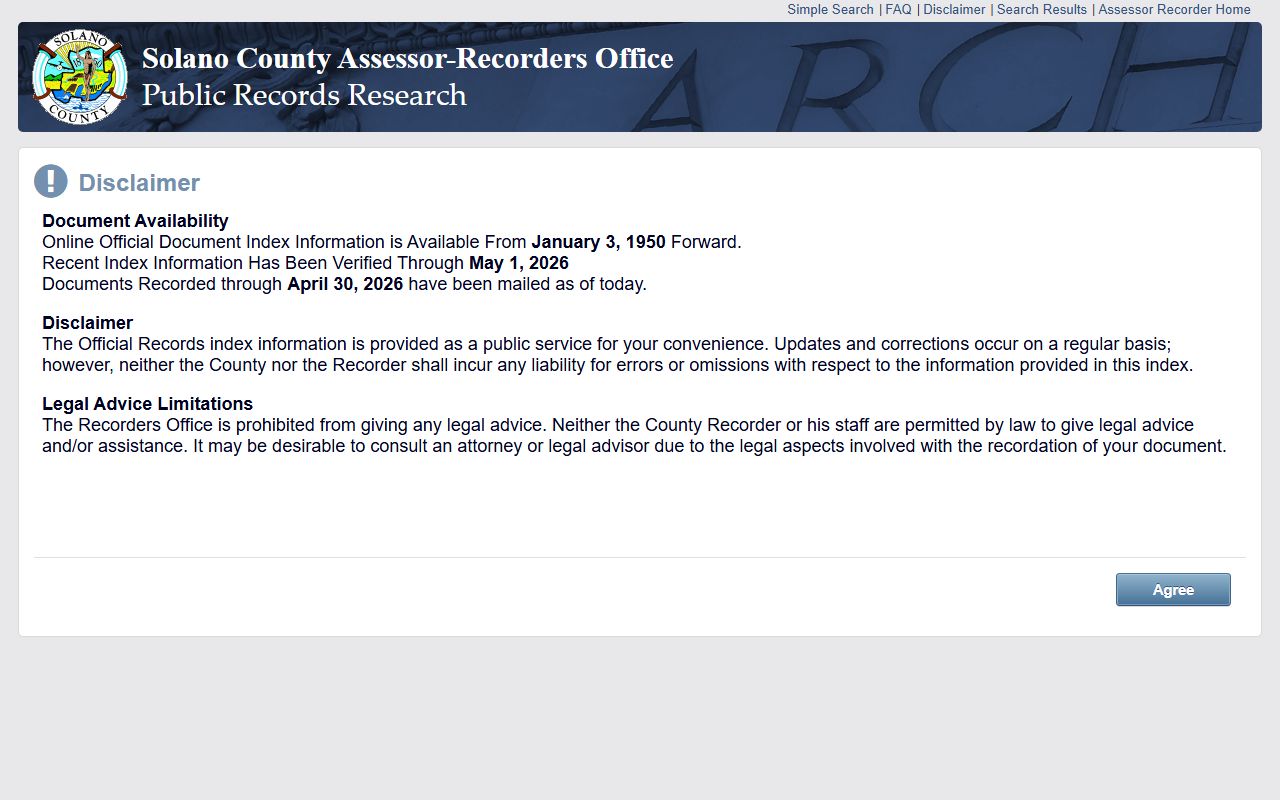
Requesting Certified Copies
Certified copies of probate orders, letters, and judgments come from the Clerk of the Superior Court. Solano uses Local Form 4021, Request for Records Search and Copies. The form asks for the case number when known, party names, date of birth where useful, and the time period if the case number is unknown. A separate request must go to each division. Payment is collected in advance by check or money order payable to Solano Superior Court.
Mail completed Form 4021 packets to the Clerk of the Superior Court at the Hall of Justice, 600 Union Avenue, Fairfield, CA 94533. The court's record-search hours are Monday through Friday, 8 AM to 3 PM, excluding court holidays. For walk-in copies, plan around the 8-11:30 AM clerk drop-in window or set an appointment. More clerk procedure detail sits on the Clerk of the Superior Court page. For a broader view of all county court files, see court records. For marriage and divorce filings, which live in the family law division of the same court, see marriage and divorce records. For the overall trial court structure see Superior Court.